
Isolated Fault, Otherwise Healthy System
A repair can be sensible when the underlying system remains suitable, parts are available and there is no pattern of recurring failures.
A failed air conditioner does not automatically need replacement, and an old system does not automatically deserve another repair. The right decision comes from the fault itself, system age, repair history, warranty status, parts availability, refrigerant condition, current performance, original sizing and the cost of restoring reliable operation.
A professional diagnosis should identify the failed component or system condition before repair versus replacement economics are compared.
A repair can be sensible when the underlying system remains suitable, parts are available and there is no pattern of recurring failures.
Age, previous repairs, current efficiency, parts support and replacement cost should be reviewed together before authorising major work.
Replacement deserves serious consideration when repair would restore a system that is still unreliable, poorly sized, inefficient or difficult to support.
The repair quote is only one part of the decision. A useful assessment asks whether the money being spent will return the system to dependable, appropriate service.
Identify the failed component or system condition first. Weak cooling, noise or water can have several possible causes.
Age is a lifecycle indicator, not an automatic replacement trigger. Older equipment deserves closer scrutiny when a major repair is required.
One isolated repair is different from several failures over successive seasons. Repeated faults can change the economics substantially.
Check the exact model, installation date, application and warranty terms before paying privately for potentially covered work.
A technically repairable fault can still be impractical if the correct part is obsolete, unavailable or uneconomic to source.
Review the current system's actual performance and suitable replacement options. Do not assume every newer unit will produce the same savings in every home.
A successful repair will not correct an air conditioner that was poorly sized, badly located or unsuitable for the way the property is now used.
Compare the cost of repair, expected remaining service, future risk and replacement benefits instead of looking only at today's invoice.
Daikin Australia currently uses two practical indicators in its repair versus replace guidance: older systems, especially those with recurring failures, deserve closer replacement consideration, and a repair approaching more than half the price of a new unit can shift the economics toward replacement.
Daikin's current Australian guidance says systems over 10 years old or breaking down often may be more economical to replace. That does not mean every 10-year old system needs replacement.
Daikin suggests replacement when a repair is more than half the price of a new unit. Use this as a decision aid, not a universal industry law.
A single repair on an otherwise appropriate system can be very different from a machine that has needed repeated major work.
A symptom can justify inspection, but the same symptom can have more than one cause. Avoid making a replacement decision from noise, weak airflow or a fault code alone.
Possible causes can range from airflow restrictions and filter condition to fan, coil, duct or system performance issues.
Decision: diagnose before assuming the unit is undersized or finished.This can involve controls, airflow, refrigeration, electrical or compressor related issues. Severity and repairability depend on the confirmed fault.
Decision: fault type matters more than the symptom description.Drainage, condensate management, installation condition or internal contamination can all require investigation.
Decision: water leakage does not automatically mean replacement.Noise can indicate loose components, fan problems, vibration, electrical issues or more significant mechanical faults.
Decision: stop treating a new severe noise as “normal ageing”.Electrical faults require appropriate licensed assessment. Repeated resetting without identifying the cause is not a repair strategy.
Decision: electrical safety comes before repair economics.A history of repeated repairs can be more important than any single invoice because it affects confidence in the remaining system.
Decision: compare total recent repair spend and future risk.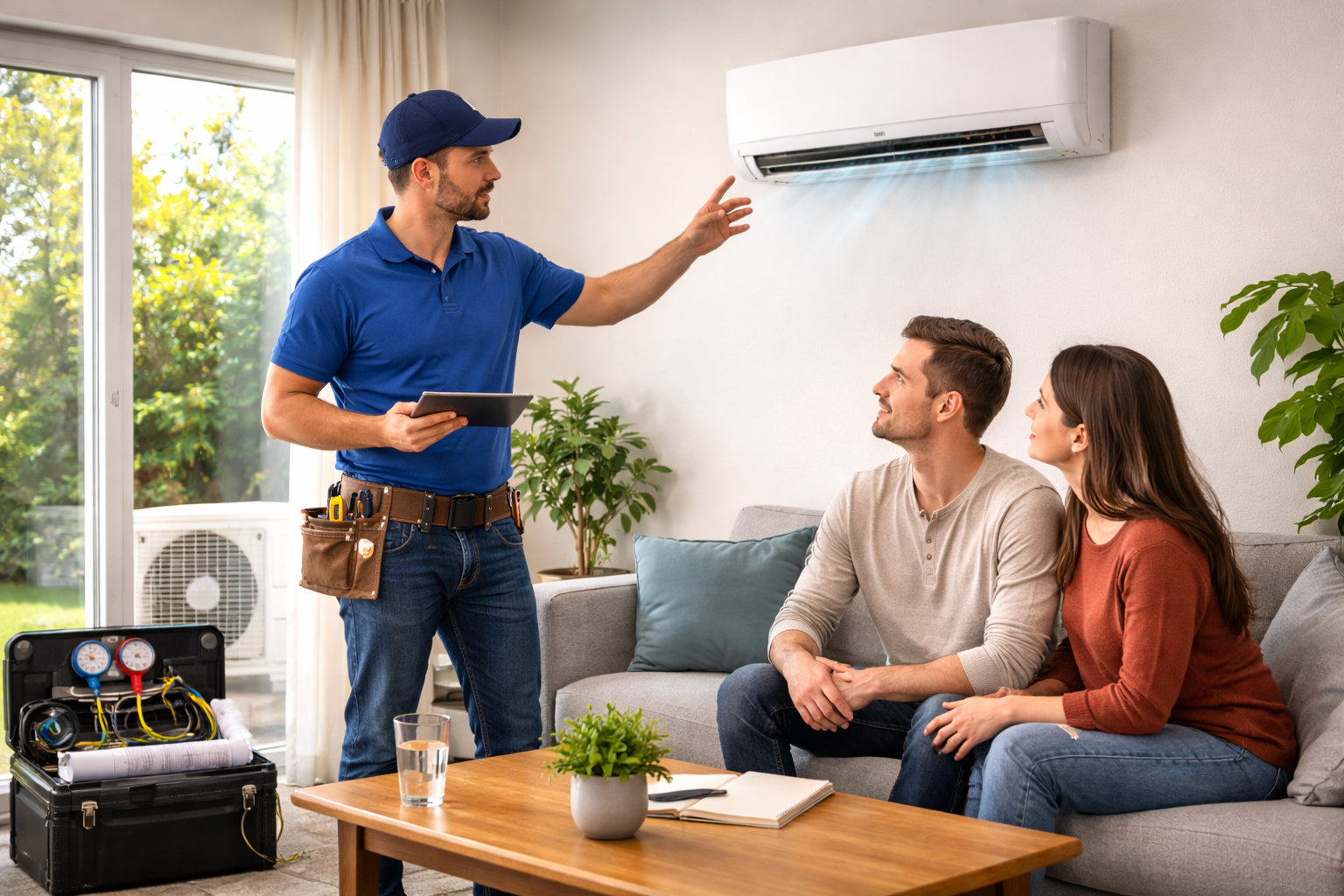
Professional diagnosis can separate a maintenance issue from a component failure, an installation problem from an equipment problem, and an isolated fault from a system that has reached an uneconomic stage of its lifecycle.
These are commonly needed for service and warranty identification. Daikin explicitly requests both for service requests.
Warranty can depend on installation meeting manufacturer requirements. Daikin states improper installation related faults are not covered under its domestic warranty.
General maintenance is not automatically a manufacturer defect. Daikin, for example, excludes routine filter cleaning from its warranty coverage.
Daikin states a 5-year domestic warranty for relevant residential products under its conditions. Mitsubishi Heavy Industries states 5-year parts and labour coverage for residential applications, subject to its terms.
Commercial, non human comfort, accessories and specialised applications can have different warranty arrangements. Check the actual warranty documentation.
These details make warranty checking, parts identification and repair history assessment much easier.
Older systems can remain repairable, but the decision changes if the required part is no longer supported, the repair needs substantial labour, or the system has other ageing components that may soon require attention.
A replacement project should not automatically copy the old equipment capacity, indoor unit position or control strategy. The home may have changed, the original system may have been incorrectly sized, and current equipment can offer different capacity ranges and controls.
Extensions, insulation, glazing, room use and occupancy can change the load.
Where the Zoned Energy Rating Label applies, compare similar capacity and feature classes rather than unrelated systems.
Timers, Wi Fi, zoning and operating schedules can influence usability and actual operating behaviour.
Airflow, service access and nearby occupied areas should be considered.
Government guidance notes insulation, shading and sealing can reduce heating and cooling loads as well.
No single item below automatically condemns a system. Replacement becomes more persuasive when several of them exist together.
Frequent call outs reduce confidence that another repair will provide dependable long term service.
At this point, compare expected remaining life, warranty on new equipment and future repair risk.
Repairing a fundamentally undersized, oversized or poorly configured system may simply restore the original problem.
Parts availability and downtime can materially change the value of an otherwise technically possible repair.
Changed room use, renovations, new occupancy patterns or comfort expectations may justify redesign rather than repair.
A properly designed new system may address capacity, controls, efficiency, zoning, noise or equipment placement together.
Start with evidence, then compare options. Do not start with a replacement sales pitch or a repair price in isolation.
Confirm the real fault and system condition.
Age, warranty, previous repairs and maintenance.
Include parts, labour, access and any related work.
Use a suitable new design, not necessarily a like for like copy.
Reliability, comfort, efficiency, warranty and future risk.
The strongest decision comes from the combined pattern, not one isolated box.
Age alone does not decide it. A repair can still make sense on an older system if the fault is minor, parts are available, the system remains suitable and there is no pattern of repeated failures. Replacement becomes more compelling when age is combined with major repair cost, recurring problems, poor efficiency, parts difficulty or an unsuitable original design.
There is no universal compulsory replacement age. Daikin Australia currently treats systems over 10 years old, particularly those with frequent breakdowns, as stronger replacement candidates and cites an average lifespan around 10 to 15 years. Actual service life depends on equipment, installation, usage, environment and maintenance.
Daikin Australia currently suggests that if a repair costs more than half the price of a new unit, replacement should be considered. It is a manufacturer rule of thumb, not a law. The comparison should use a suitable replacement system and include warranty, expected remaining life and broader system condition.
Not automatically. The location, cause, repairability, equipment age, parts support and overall condition matter. Refrigerant work should be performed by appropriately licensed personnel, and the underlying leak or fault should be identified rather than simply treating refrigerant loss as routine consumption.
Check the manufacturer's warranty process before authorising private work. Coverage depends on the exact product, application, installation and warranty conditions. Keep the model number, serial number and installation or purchase records available.
A suitable newer system may offer better efficiency than some older equipment, but actual electricity use also depends on capacity, thermostat settings, operating hours, zoning, climate and the building itself. Compare suitable equipment rather than assuming a fixed percentage saving.
Not automatically. The original unit may have been incorrectly sized, and the property may have changed through renovations, glazing, insulation or room use changes. Capacity should be reassessed before selecting replacement equipment.
Useful information includes the model and serial numbers, approximate installation date, fault code if shown, what the system is doing, when the problem started, previous repairs and whether the issue affects heating, cooling or both. Do not open electrical or refrigerant components yourself to gather information.
Owner maintenance should stay within the manufacturer's instructions, such as appropriate filter care. Refrigerant related and electrical repairs require the relevant technical and licensing scope. Western Australia requires electrical work to be carried out by appropriately licensed people.
Price replacement when the repair is substantial, the system is older with recurring faults, parts support is declining, the current equipment is unsuitable for the property, comfort remains poor even when functioning, or replacement could resolve several issues at once. Pricing both options does not mean replacement is automatically the right choice.
The best outcome is not automatically the cheapest repair or the newest machine. It is the option that restores dependable, correctly sized comfort with sensible lifecycle value for the property.